
“I feel like a failure”
“I feel like I’m falling behind”
“I can’t keep up”
“Everyones better than me”
These are the feelings we all face at some stage in our lives. The internet only makes it worse, now we compare ourselves to others daily. We are bombarded by the posts of others’ success.
Maybe we can partly blame evolution for this feeling. We’re naturally inclined to feel dissatisfied or to be driven towards finding more satisfaction in life so that we will keep moving forward, doing the things that help us survive and succeed (Veenhoven, 1996; Kageyama & Sato, 2021).
Note: If you would like to just learn the strategies you can skip to “How to Stop Feeling like a Failure.” Otherwise read on to understand the theory behind these feelings.
Problem 1: You’re focused on everyone else.
Maybe you’re thinking, “I really am a failure, I’m not succeeding in life, everyone else is doing so much more”. What standards are you measuring yourself by?
Take your standard and go through this list of people to decide who is a success and who is a failure:
- A 5 month old baby who hasn’t uttered a word.
- A student who failed their exam
- A person who makes $40k a year
- A 30 year old who lives with their parents
How did you do? Was anyone neither? Maybe you thought, there’s not enough information here to make that decision?
Now if you compare yourself to these people, how are you doing? I believe, compared to the baby, you’re doing quite well because you’re reading this post.
“Why would I compare myself to a baby”
Why not compare yourself to a baby? I imagine it’s because they’re at a different stage of life.
But we all are.
There is not a single person on Earth who you can fairly compare yourself to because the different environments and circumstances we experience places us at different stages. When we’re born, we’re not put on the same starting line.
Problem 2: These thoughts are given power.
Maybe it feels hopeless and like you’re subjected to challenges that others don’t have. Challenges that you have no control over. It’s true, there are many things in life we cannot control.
The only two things forever in our control are how we think and how we act. Do you agree?
We can’t ask people to stop posting their achievements online which makes us feel bad. But we can change our thoughts when we see those posts (or we can take action by uninstalling social media).
For some people, they probably know where this is going and they don’t want to hear it. “I’m tired of people telling me to just think positive.”
I get it and I don’t want to do just that (in fact, in this post I’ve listed a few different approaches so that maybe you’ll find something that feels right for you).
I’m not going to say the answer to your lifelong misery is to “just think positive”. If it were that easy, the google searches for “I feel like a failure” wouldn’t look like this:
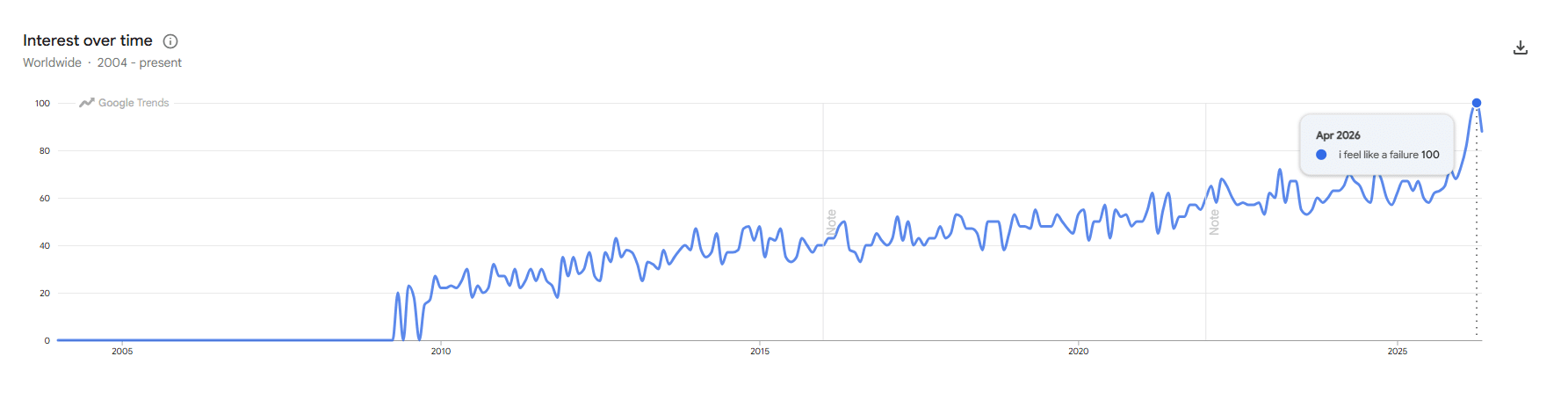
22k searches over the last month…How is it that so many of us feel like a failure.
Some might feel resistant to the idea of looking inwards at their thoughts and feelings, maybe it makes you cringe, or it feels uncomfortable.
I understand looking inwards can feel like “airy, fairy, yoga nonsense.” You’ve probably heard the terms “mindfulness”, “gratitude” and “just think positively” too many times and meditation never worked for you. But science backs up the power our thoughts have over us.
A review of more than 4,000 studies involving over 500,000 participants found that positive psychology activities (changing your thoughts towards positive thinking) can help reduce anxiety, stress, depression and improve overall wellbeing (Carr et al., 2024). That’s a whole lot of research pointing in the same direction
Again, these negative feelings are partly an evolutionary response to motivate us to keep moving forward. For some of us, it works out, but for those googling “I feel like a failure”, it might feel like you’re being dragged down rather than forward.
Negative feelings become a problem when they overwhelm you and make it harder to get out of bed in the morning. These feelings can be really hurtful, breaking down your self-esteem and sense of self (Mulawarman et al., 2025).
How to Stop Feeling Like a Failure
The answer seems like it would be simple: just start achieving. Maybe you’ve tried this and it feels good for a while but then that feeling creeps back in… You do more and more but it seems like you can’t catch a break for long.
Problem 3: The problem hasn’t changed.
You’ve slapped a bandaid on top, a temporary fix. Or maybe you’ve developed another workaround to cope, or avoid it…as much as you can. You haven’t yet addressed the root of the problem: the negative thoughts. What if you changed how you think?
Many of the world’s most famous thinkers (philosophers) believed this was the answer to handling the ups and downs of life.
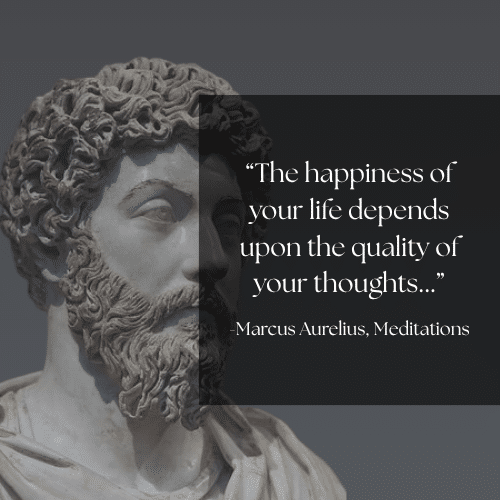
Remember: The two things in our lives we have control over are how we think and act.
You can’t get your friends to stop talking about their achievements but you can change what you think when you hear them.
There is no magic tool, resource or treatment that will change your thinking in an instant. It takes patience and time to retrain yourself out of the negative thinking patterns you’ve developed in response to your past environments.
Psychology has developed many ways of addressing your negative thoughts. Although Cognitive Behavioural Therapy (CBT) is regarded as the most effective therapy in Psychology, when it comes to our unique minds, there is no one-size-fits-all approach. So I have listed a variety of ideas from different therapies that may help.
If one approach doesn’t work for you, don’t give up; try out another technique.
Cognitive Behavioural Therapy (CBT)
Our thoughts are not always fact. Some people develop a lens that distorts reality, leading to negative thinking. For example, situations like going to a party may make you feel dread because you assume the worst will happen. CBT names this as the Fortune Telling distortion. Do you recognise any of the below cognitive distortions in your own thinking:
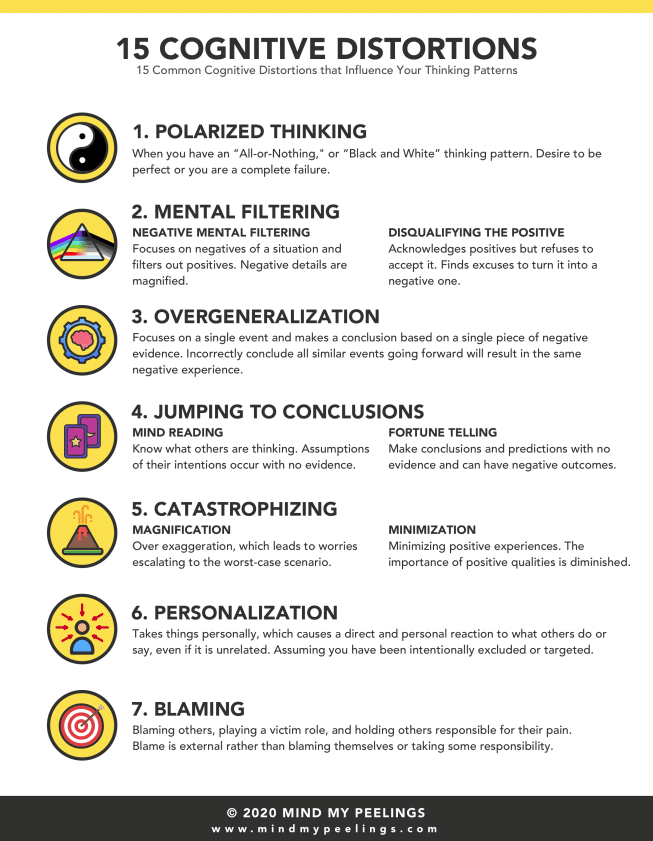
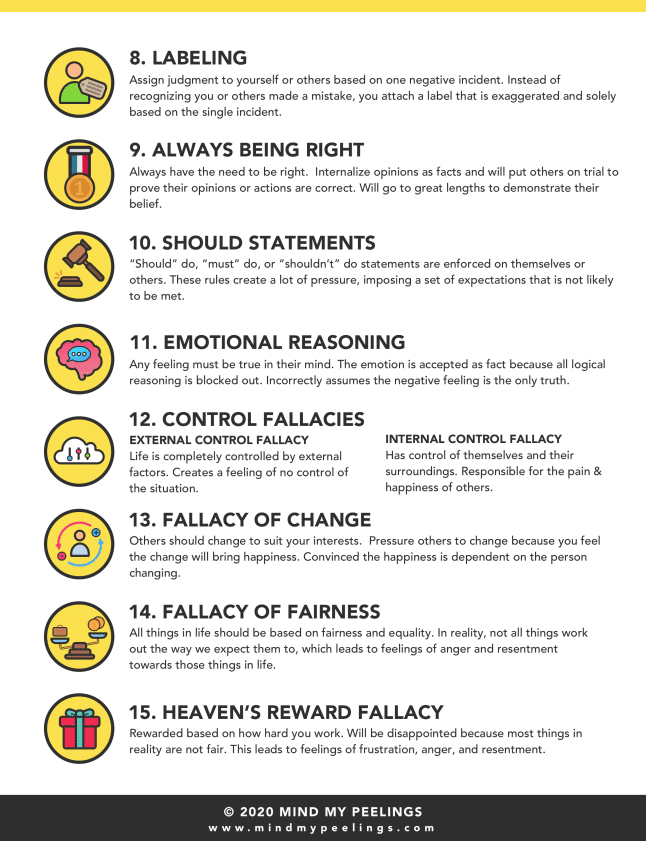
Learning to identify your cognitive distortions when they appear is the first step. Next is to turn it into a habit and learn to challenge your thoughts. Here’s a video to help:
How to Stop Cognitive Distortions: Bad Thoughts and Poison Minds
If you are finding it difficult to identify your cognitive distortions, talking with a therapist might help.
Acceptance and Commitment Theory
When we compare our lives to those of others, we may begin to lose sight of ourselves. You may pick up goals that don’t truly align with your values. So one place to start may be rediscovering yourself and your values. Here are two videos to help you start:
How to find your Values | Lottery exercise from Acceptance and Commitment Therapy Values Exercises
How To Identify Your Core Values: Acceptance and Commitment Therapy (ACT)
ACT also teaches something called Cognitive Defusion. It’s about creating space from your difficult thoughts and feelings. When that thought “I feel like a failure” is at the front of your mind, it can be really hard to get past it and do anything. This is where the Cognitive Defusion technique may be useful:
Cognitive Defusion EXPLAINED: Acceptance and Commitment Therapy (ACT)
Cognitive Fusion and Defusion in ACT (Acceptance & Commitment Therapy)
Compassion Focused Therapy (CFT)
CFT recommends you to start treating yourself like a friend. Feeling shame and punishing yourself only creates more damage, struggle, and makes it harder to feel motivated to do anything. Be self-compassionate. If you feel like you’re struggling with being overly critical towards yourself, you might like this:
If you want to explore this further, a compassion-focused trained therapist can help you.
Solution-Focused Brief Therapy (SFBT)
For those who don’t find looking inward helpful. Try solution-focused therapy or ask yourself solution-focused questions that redirect your thinking away from the problems and negative thoughts:
- What makes you feel like you’re ahead in life?
- What makes you feel good?
- When do you feel proud of yourself?
- When do you feel like you’re doing well?
Build Back Your Self-Esteem, Self-Confidence and Your Sense of Self
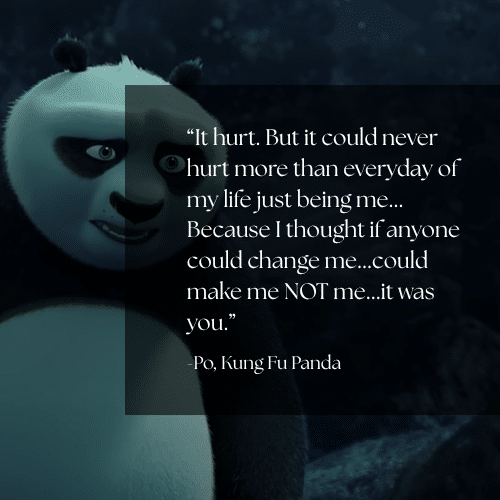
Part of not feeling like a failure, and not feeling the need to compare yourself to others, comes from self-esteem. Self-esteem is about self-love, how you value yourself and how confident you feel in who you are.
What makes self-esteem so important?
Imagine this scenario: You’re wearing your normal everyday clothes. Now, a stranger walks up to you and says: “That’s a stupid pink unicorn outfit, you look really silly in that.”
What’s your reaction?
I imagine it might be disbelief and confusion. You’re not wearing a pink unicorn outfit? What is this crazy person on about…Instead of internalising it and becoming self-conscious, you just think they’re wrong, and they’re the ones who must be confused.
How do you begin to treat all scenarios like this one?
One place to start may be relearning who you are and what you love. You can’t be confident in yourself if you don’t know yourself. Here are some ideas to help you rediscover yourself:
- Find your strengths with this test: https://www.viacharacter.org
- Rediscover your passions
- What did you like doing as a kid
- Try out something new every week
- Spend time with yourself and be present. Journal to record your inner thoughts, or maybe take a walk on your own and just let yourself think.
For another take on finding yourself, I highly recommend watching this video, it explains the story of Po from Kung Fu Panda.
This is a story remembered for training hard and believing in yourself. But the story goes deeper. It’s actually the story of accepting who you are and that you need to let go of this ideal/perfect version of yourself that you’re trying to be:
What Kung Fu Panda Teaches Us About Letting Go
Gratitude
The word gratitude can feel overused or like cheap, low-effort advice. But there is real science behind the importance of gratitude.
It directly counteracts negative feelings in your brain. It sounds too simple but things like gratitude journaling can really help to change the way you think, for the better. Regular gratitude practice can gradually change the way we interpret situations by shifting our attention toward positive aspects of life (Kini et al., 2016).
Gratitude is the reason some people with very little can still find contentment.
Check out this video to learn more about gratitude:
An Antidote to Dissatisfaction
5 Ways to Practice Gratitude
- Write 3 things you’re grateful for each day
- Tell someone why you appreciate them
- Take one photo of something you appreciate each day
- Pay It Forward – Share something you have with someone else (food, shelter, skills, knowledge)
- Gratitude Jar – Every time you think of something you are grateful for, put it on a strip of paper into a jar. When you need to be reminded of what you are grateful for, take one from the jar
Explore philosophy
If you’re a very intellectual, curious person or you just love learning you might like this. Many philosophies have great teachings that can help us learn to love ourselves and to let go. Here are some examples that may interest you:
Taoism
Lao Tzu’s Secrets to Stress-Free Living | Taoist Philosophy
Buddhism
The Art of Letting Go – The Philosophy of the Buddha
Stoicism
Stoicism & the Art of Worrying Less
References
Carr, A., Finneran, L., Boyd, C., Shirey, C., Canning, C., Stafford, O., … & Burke, T. (2024). The evidence-base for positive psychology interventions: A mega-analysis of meta-analyses. The Journal of Positive Psychology, 19(2), 191-205.
Kageyama, J., & Sato, K. (2021). Explaining the U-shaped life satisfaction: Dissatisfaction as a driver of behavior. Journal of Bioeconomics, 23(2), 179-202.
Kini, P., Wong, J., McInnis, S., Gabana, N., & Brown, J. W. (2016). The effects of gratitude expression on neural activity. NeuroImage, 128, 1-10
Mulawarman, M., Antika, E. R., Hariyadi, S., Miftachul‘Ilmi, A., Prabawa, A. F. I., Benu, K. M., … & Lathifah, A. A. (2025, April). The Influence of Positive Self-Talk on Students’ Self-Criticism: a Cross-Sectional Study. In The 8th International Conference on Education Innovation (ICEI 2024) (pp. 811-818). Atlantis Press
Veenhoven, R. (1996). The study of life-satisfaction.